Treating PTSD as a Brain Injury, Not Just a Psychological One
Post-traumatic stress disorder is typically treated with psychotherapy and medication, and for many people, that’s not enough. Brain imaging research over the past decade has shown that PTSD involves measurable changes in brain activity and microstructure, particularly in the fronto-limbic circuit, amygdala, and medial prefrontal cortex, the same regions involved in fear response and emotional regulation.
That imaging evidence is what led researchers to test whether hyperbaric oxygen therapy (HBOT), already studied for its neuroplasticity effects in brain injury and for treating post-concussion symptoms, could help PTSD directly.
In this post, we’ll dive into what exactly PTSD is, how hyperbaric oxygen therapy can help, and further into the evidence behind this promising new way of treating PTSD symptoms.
What is PTSD?
Post-traumatic stress disorder (PTSD) is a mental health condition triggered by experiencing or witnessing a traumatic event. This can include events such as military combat, natural disasters, serious accidents, or personal assaults. Common symptoms of PTSD include intrusive traumatic memories, flashbacks related to past traumatic events, intrusive thoughts, nightmares, severe anxiety, and emotional distress.
These reactions can persist long after the traumatic event has ended, severely impacting a person’s daily life and relationships.
And What is Hyperbaric Oxygen Therapy?
Hyperbaric oxygen therapy (HBOT) is a medical treatment that involves breathing pure oxygen in a pressurized environment, most often a hyperbaric chamber. Traditionally used to treat decompression sickness in divers, HBOT has broadened its scope to address a variety of conditions, particularly those involving wound healing and brain injuries.
The increased pressure allows oxygen to dissolve more effectively into the bloodstream, promoting healing and reducing inflammation, including brain inflammation.
With its ability to enhance neural plasticity, HBOT has been among the next targets in the search for treating various neurological conditions, including post-concussion syndrome, traumatic brain injury (TBI), and, yes, PTSD, with hopes of benefiting those whose cognitive function has been altered by traumatic stress.
What the Research Shows About HBOT for Treating PTSD Symptoms
As research into post-traumatic stress disorder (PTSD) progresses, scientists are discovering innovative treatment approaches beyond traditional therapy and medication.
Among these emerging options is hyperbaric oxygen therapy (HBOT), which has shown promise in relieving PTSD symptoms.
Let’s explore current research findings and what they reveal about HBOT’s potential effectiveness for individuals living with PTSD, especially those who have experienced a traumatic event.
Is there Real Controlled-trial Evidence, or Just Case Reports about HBOT sessions?
There’s a genuine randomized controlled trial here, which is uncommon in the sphere of PTSD treatment. Researchers at Tel Aviv University and the Sagol Center for Hyperbaric Medicine and Research at Shamir Medical Center studied veterans with treatment-resistant PTSD, whose symptoms persisted despite trauma-focused therapy and pharmacological treatment. They were randomized to hyperbaric oxygen therapy or a control group. The HBOT group showed a statistically significant improvement in PTSD symptom scores (CAPS-V), while the control group showed no change over the same period.
The researchers also reviewed each participant’s medical history as part of the study’s strict screening and exclusion criteria. This is done to help distinguish PTSD from other neurological and medical conditions. Participants with a history of traumatic brain injury or any other brain pathology, severe or unstable physical disorders, or major cognitive deficits at baseline were excluded. Participants also needed to be able to undergo an awake brain MRI, since neuroimaging was an important part of evaluating changes in brain structure and function.
Alongside CAPS-V, researchers used the Brief Symptom Inventory (BSI-18) and Beck Depression Inventory-II (BDI-II) as secondary clinical measures. The study also used diffusion tensor imaging (DTI) and functional MRI (fMRI) to evaluate brain microstructure and brain function, allowing researchers to compare changes in clinical symptoms with changes observed through neuroimaging.
HBOT was later tested again in a randomized, sham-controlled trial, this time against a true placebo condition rather than an untreated control. The study compared 2 ATA HBOT with a 1.02 ATA sham treatment in veterans with combat-associated PTSD and again found significantly greater improvement in PTSD symptoms in the HBOT group.
Was This Tested Against a True Placebo, Not Just an Untreated Control?
Yes, a follow-up sham-controlled trial specifically compared real hyperbaric therapy (2 ATA) against a sham condition (patients believed they were receiving treatment, but pressure was kept at a negligible 1.02 ATA). This design is significant as it helps rule out the placebo effect of simply spending time in a hyperbaric chamber. Response rates and symptom reduction were evaluated against this true placebo comparison, highlighting the potential of hyperbaric oxygen to enhance cognitive function and ameliorate PTSD symptoms.
Did the brain imaging back up the symptom improvement after HBOT?
Yes. In addition to clinical symptom scores, researchers used brain imaging technology, such as diffusion tensor imaging (DTI) to assess brain microstructure, and functional MRI (fMRI) to assess brain activity during cognitive tasks. Following hyperbaric oxygen therapy (HBOT) at 2 ATA, veterans showed measurable improvements in both brain microstructural integrity and functional brain activity, specifically hippocampal activity in the fronto-limbic circuit, the same circuit implicated in PTSD’s underlying pathology. The neuroimaging results are a meaningful kind of evidence and information beyond self-reported PTSD symptom relief alone.
Do the benefits last, or fade after HBOT treatment ends?
A long-term follow-up study evaluated outcomes for the veterans at least one year after HBOT treatment ended. It found the clinical improvement in chronic symptoms of PTSD was sustained, along with additional long-term benefits in social functioning, memory, and mental clarity, and a decrease in medication use, suggesting that HBOT’s effect on brain networks isn’t just a short-term boost that fades once sessions stop.
What HBOT protocol did these trials use?
The clinical trials followed a consistent protocol involving 60 daily HBOT sessions, each lasting 90 minutes. Participants were exposed to 100% oxygen levels at 2 ATA, five days a week. To ensure safety and avoid oxygen toxicity, sessions included brief air breaks. These breaks also simulate “perceived hypoxia,” which triggers a regenerative response without causing true hypoxic damage. This powerful signal enhances neuroplasticity, encourages stem cell proliferation and migration, stimulates angiogenesis (the creation of new blood vessels) and cerebral blood flow, increases oxygen delivery, modulates inflammation, and boosts mitochondrial metabolism.
Together, these processes support the repair of injured brain regions, supporting enhanced cognitive function and reduced symptoms related to combat-related PTSD and other traumatic events.
It’s the same core protocol used at the Sagol Center for Hyperbaric Medicine and Research for PTSD and traumatic brain injury, achieving more significant pressure than mild wellness chambers.
Quick Facts Sidebar
- Protocol used across trials: 60 sessions, 90 min, 2 ATA, 5 days/week
- Tested against: both untreated controls and true sham (placebo) conditions
- Outcome measures: CAPS-V clinical symptom scores, DTI brain microstructure imaging, functional MRI
- Population studied: veterans with treatment-resistant combat-associated PTSD
- Durability: clinical improvement sustained at 1+ year follow-up
Why HBOT Chamber Type Matters Here
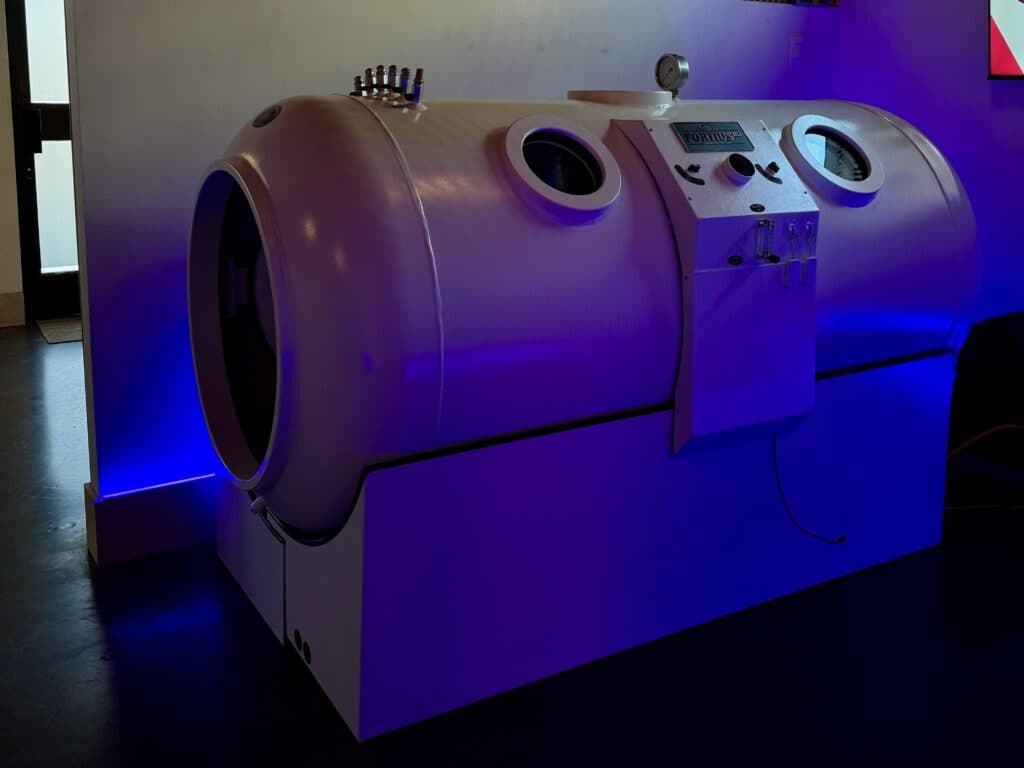
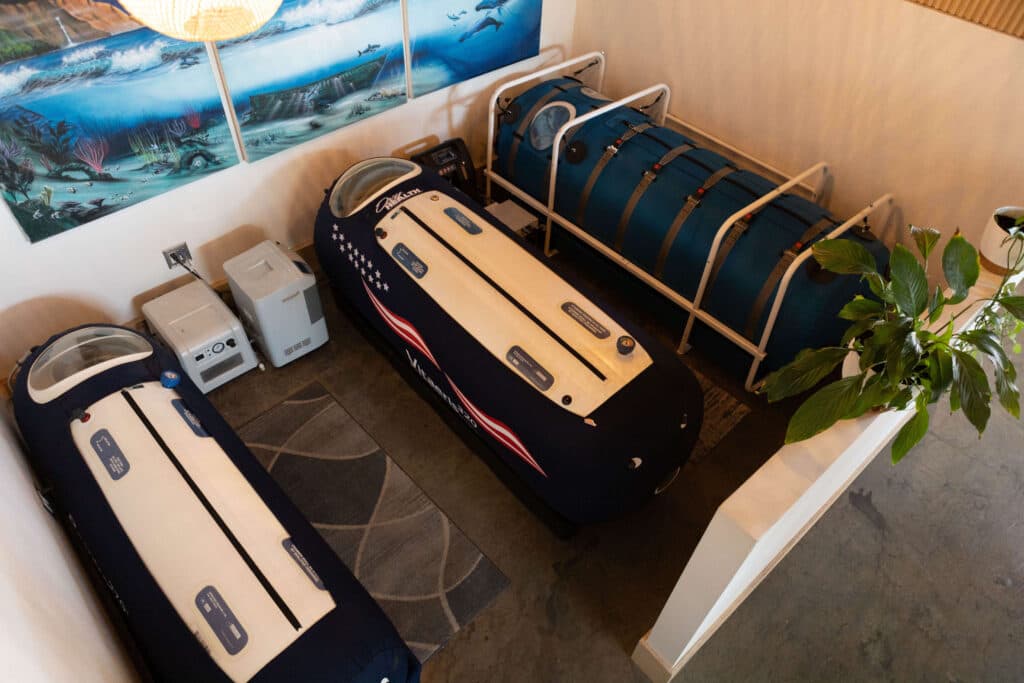
This entire research program, from the original RCT through the sham-controlled trial and long-term follow-up, was conducted at 2 ATA for each effective HBOT session, a pressure that requires a hard-shell, hospital-grade HBOT chamber to reach and hold safely for 90-minute sessions. Our HBOT Fortius chamber, reaching 2.0–2.2 ATA, operates in the same range used throughout this research.
Hyperbaric Oxygen Therapy for PTSD: Why Choose ReEnergized
If you or someone you know has been through trauma-focused therapy and medication without full symptom relief, hyperbaric oxygen therapy for treating PTSD symptoms is a genuinely evidence-backed area worth knowing about, not as a replacement for psychological care, but as a complementary, physiologically-grounded option. Let’s talk about what a realistic HBOT protocol looks like and how it might fit alongside the care you’re already receiving.
HBOT for PTSD should be pursued alongside your psychiatrist or therapist, not as a replacement for psychotherapy or medication. This article summarizes published clinical trial research for educational purposes and is not medical advice. If you or someone you know is struggling with PTSD or having thoughts of self-harm, please reach out to a mental health professional or crisis line for support.