HBOT for Sports Injuries
Back To BlogHyperbaric Oxygen Therapy

HBOT for Sports Injuries: Ligament, Tendon & Fracture Healing at 2.0+ ATA

Recovery Time Is a Competitive Advantage

For athletes, dealing with their sports injuries isn’t as straightforward as just healing a physical wound.

The recovery process needs to be optimized because sports injuries like torn ligaments, muscle damage, stress fractures, or strained tendons don’t simply affect performance today; they can lead to extended downtime, affecting future competition schedules. That’s why there’s growing interest in hyperbaric oxygen therapy (HBOT) as a complement to standard sports medicine care. At higher pressures, HBOT is known to enhance tissue healing by increasing tissue oxygen tension, reducing inflammation, and promoting blood vessel growth. This therapy accelerates recovery, offering athletes a competitive edge.

What Hyperbaric Oxygen Therapy Is and What the Research Shows

Hyperbaric oxygen therapy (HBOT) involves breathing pure oxygen in a specially designed chamber where the air pressure is increased to levels higher than normal atmospheric pressure.

Traditionally used to treat decompression sickness in divers or for treating carbon monoxide poisoning, those hyperbaric chambers are now increasingly employed as therapy for treating a wide range of conditions, symptoms, and even wound healing.

Hyperbaric oxygen therapy, also known as HBO therapy, has recently gained traction for its potential to accelerate recovery from sports injuries in athletes.

Higher-pressure conditions enable more oxygen to dissolve in the bloodstream, thereby facilitating enhanced delivery to injured tissues.

This heightened oxygen availability in blood vessels and cells can accelerate the body’s natural healing processes, reducing inflammation, promoting cell repair, and decreasing recovery time for athletes. In recent years, numerous studies have highlighted the efficacy of HBOT —particularly when administered at pressures above 2.0 atmospheres absolute (ATA) in hard-shell hyperbaric chambers — in expediting ligament, tendon, and fracture healing.

Does HBOT actually speed up ligament healing?

The strongest human evidence here comes from a double-blinded controlled study from the University of British Columbia on treating medial collateral ligament (MCL) injuries with hyperbaric oxygen therapy. Patients treated with HBOT at 2 ATA for 60 minutes across 10 sessions showed faster reduction in swelling, less muscle wasting, and greater range of motion compared to controls. Separate laboratory research has shown that HBOT at 2 ATA promotes procollagen gene expression and favorably shifts the balance of enzymes involved in medial collateral ligament remodeling, offering a plausible mechanism behind the clinical result.

What about using HBOT for treating tendon injuries, specifically?

Research on tendon-to-bone healing, relevant to sports injuries like rotator cuff tears, found that hyperbaric oxygen therapy (HBOT) at 2 ATA for two-hour sessions significantly enhanced vascularization at the tendon-bone junction. The hyperbaric oxygenation promoted collagen fiber regeneration and improved the tensile strength of the healed tendon-bone complex compared to untreated controls. This increase in vascularization aids in delivering more oxygen, which is crucial for tendon recovery and tissue repair.

Is there evidence for healing muscle injuries, too, with HBOT?

Yes, a prospective study using hyperbaric oxygen therapy at 2.5 ATA for 60-minute sessions examined muscle recovery. The study added to a broader pattern across sports medicine research: higher-pressure protocols (2.0–2.5 ATA) in HBOT consistently outperform lower-pressure conditions on markers of tissue repair and inflammation reduction. Hyperbaric oxygen therapy enhances blood vessel formation and can decrease inflammation, which are vital aspects for faster recovery in muscle injuries.

HBOT for treating fractures

Clinical experience from hyperbaric oxygen units treating athletes has reported faster recovery times in fractures and ligament injuries, but rigorous, controlled human trials specifically isolating fracture healing are still limited. Much of the strongest fracture-related evidence comes from animal and laboratory research rather than large human trials. If nonunion fracture healing is your primary goal, HBOT serves as a promising adjunct within your orthopedic care plan, with potential benefits in increasing bone marrow edema recovery and aiding in osteosynthesis.

What HBOT pressure and protocol do these studies actually use?

Across the sports medicine literature and in systematic reviews, effective protocols for hyperbaric oxygen therapy cluster at 2.0–2.5 ATA. Treatments generally last for 60–120 minute sessions, with courses ranging from about 5 to 30 sessions depending on injury severity. This pressure is consistently higher than the 1.3 ATA range used by many commercial HBOT services, and is sufficient for stimulating vascular endothelial growth factors, or neovascularization, and enhancing collagen production within the tissues. During hyperbaric oxygen therapy sessions, tissue oxygen tension increases significantly, facilitating faster and more effective recovery for sports injuries.

Quick Facts Sidebar

  • Clinical pressure range for injury healing: 2.0–2.5 ATA
  • HBOT for MCL injury study: 2 ATA, 60 min, 10 sessions — faster swelling reduction, greater range of motion
  • Tendon-bone healing: 2 ATA, 2-hour sessions — improved vascularization, tensile strength
  • Muscle injury study: 2.5 ATA, 60 min sessions
  • Fracture evidence: promising clinically, still developing in controlled human trials
  • Used by: professional hockey, basketball, and soccer teams as an adjunctive recovery tool

Why Chamber Type Matters When It Comes to HBOT

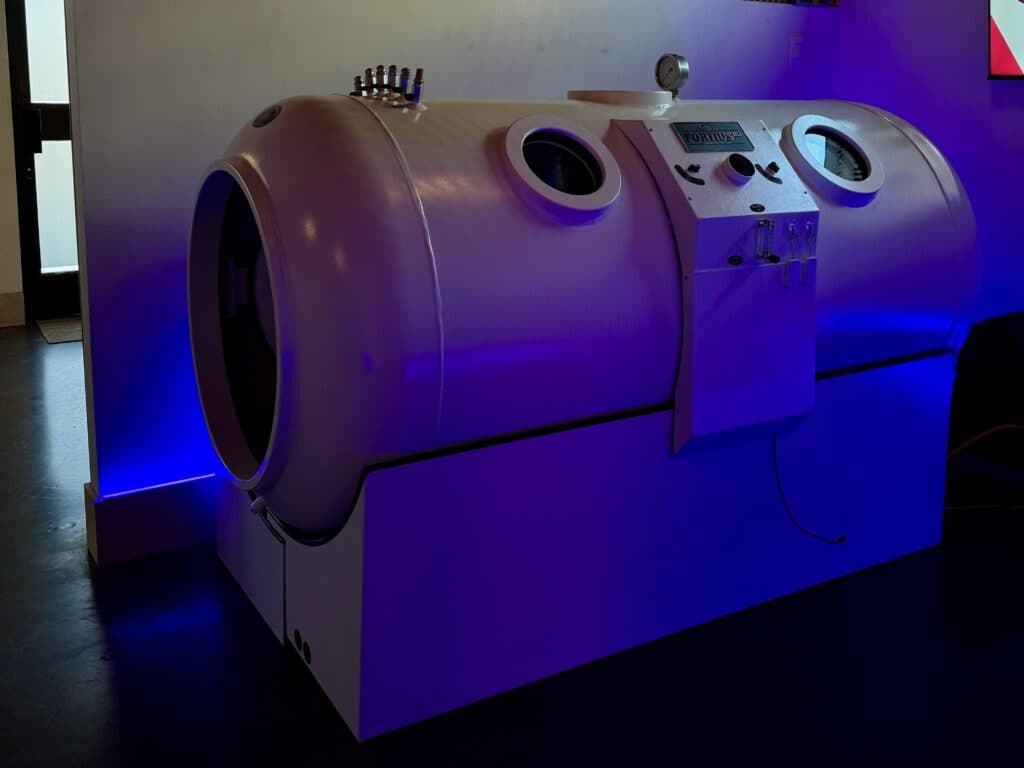
Nearly every study showing a measurable tissue-healing effect, inflammation reduction, collagen regeneration, and improvement in tensile strength was conducted at a hyperbaric oxygen therapy pressure of 2.0 ATA or higher. A hyperbaric chamber capped at 1.3 ATA simply isn’t operating in the pressure range on which this sports medicine evidence is built. Our Fortius chamber, a hard-shell, hospital-grade hyperbaric oxygen unit reaching 2.0–2.2 ATA, optimizes recovery for athletes by putting them in the same hyperbaric oxygen pressure range used across this research.

Hyperbaric Chamber Therapy for Your Sports Injuries: Why Choose ReEnergized?

Whether you’re recovering from a medial collateral ligament sprain, a tendon strain, or a stress fracture, our team will guide you through a hyperbaric oxygen protocol built around what the research supports, and be honest about where the evidence is strong versus still emerging. HBOT works best as part of a coordinated sports medicine recovery plan alongside your physical therapist or orthopedist, not as a replacement. Hyperbaric oxygen therapy is known to enhance tissue oxygen tension and speed recovery for various sports injuries, including muscle injuries, while helping reduce inflammation and promoting vascularization.

HBOT for sports injuries should be coordinated with your physician, physical therapist, or orthopedic provider. This article summarizes published research for educational purposes and is not medical advice.

Related Reading